


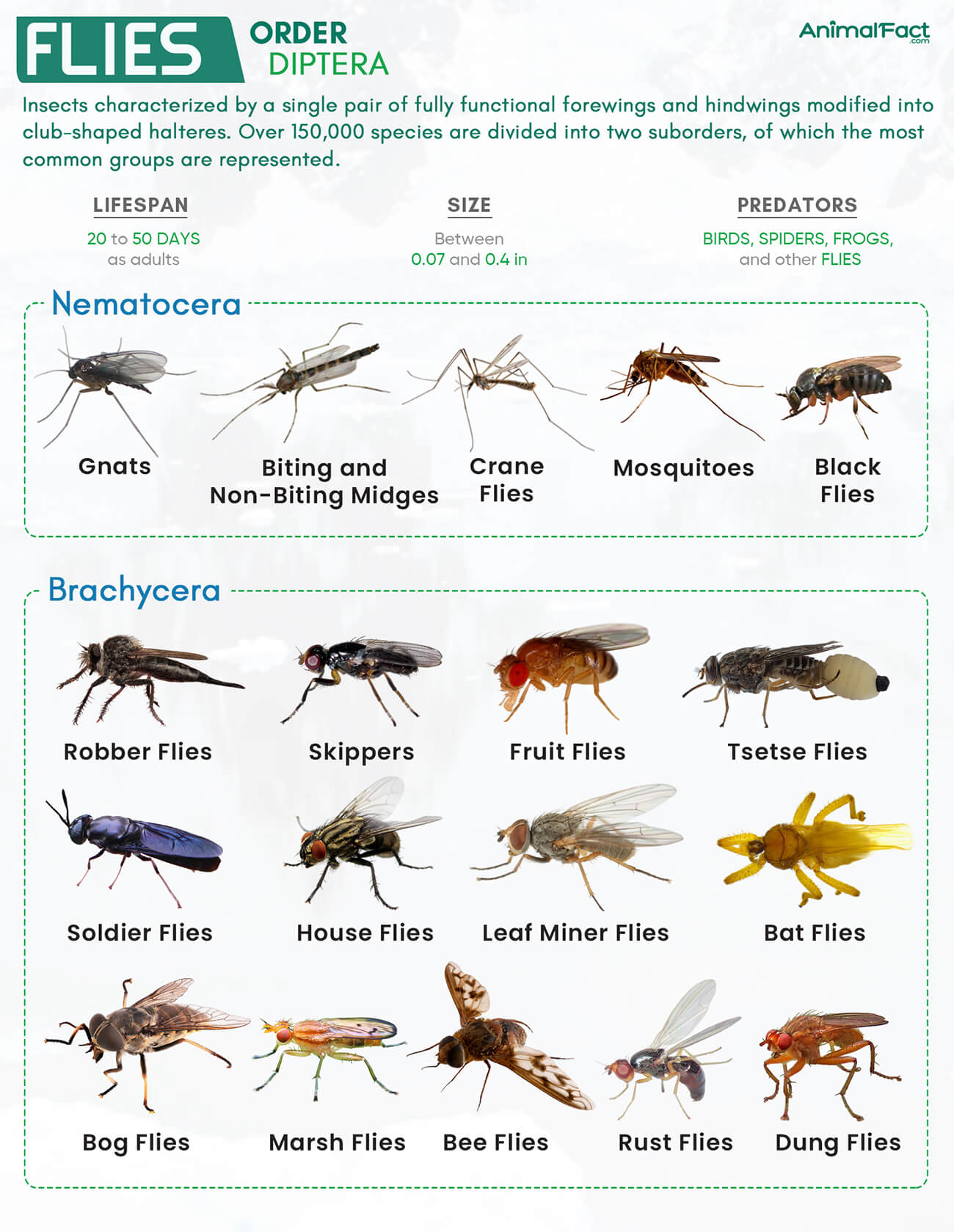
Flies are insects of the order Diptera, characterized by a single pair of fully functional wings, the forewings. Their hindwings are modified into small club-like structures called halteres, which aid in balance during flight.
They represent one of the most diverse insect orders, having over 150,000 species, including gnats, crane flies, houseflies, hoverflies, and mosquitoes, among others. These insects undergo complete metamorphosis (holometabolous), going through four life cycle stages: egg, larva, pupa, and adult.
While some flies, such as blowflies, play an important role in recycling soil nutrients, others, like mosquitoes, act as vectors of diseases that affect humans.
Although most flies are between 0.07 and 0.4 in (2 and 12 mm) long, the largest species, Gauromydas heros, measures up to 2.8 in (7 cm). The smallest species, Euryplatea nanaknihali, is tinier than a grain of salt, measuring only about 0.016 in (0.4 mm).
As insects, flies have three primary body segments: head, thorax, and abdomen.
This region bears a pair of antennae, mouthparts, a pair of compound eyes, and, in most species, three simple eyes (ocelli).
The thorax is further segmented into three subdivisions: pro-, meso, and metathorax, each bearing a pair of legs. Each leg bears five segments: coxa, trochanter, femur, tibia, and tarsus. The tarsus bears claws, at the base of which lie cushion-like, adhesive structures known as pulvilli.
The mesothorax is enlarged and bears the only pair of functional wings, the forewings, along with powerful flight muscles that control the movement of these wings.
The metathorax bears modified hindwings, the club-shaped, mechanosensory halteres, which help maintain balance and agility when in flight. The halteres are high-speed sensors of rotational movement that allow flies to perform advanced aerobatics in the air.
Some flies, such as those in the families Nycteribiidae and Streblidae, have lost their wings and are flightless.
The abdominal segment bears 8 to 10 segments in modern flies (the number varies with species), whereas primitive flies had 11 segments. The last two segments bear the reproductive organs. Each segment is covered with a dorsal plate (tergite) and a ventral plate (sternite).
Some flies, such as crane flies, bear paired sensory appendages called cerci at the posterior end of the abdomen. In some females, such as those of fruit flies, the sclerites roll into an ovipositor organ that aids egg-laying.

The order name, Diptera, derives from the Greek words di (two) and pteron (wing), although the insects of this group have only one functional wing.
Over 150,000 species of flies are traditionally divided into two suborders: Nematocera and Brachycera. Members of Nematocera have elongated bodies with long, multi-segmented, feathery antennae, while those of Brachycera are more rounded and have shorter antennae with fewer segments.
A 2015 study revealed that Nematocera is a paraphyletic group, since it excludes the Brachycera, although Brachycera evolved from within the nematoceran lineage.
The earliest true flies date back to the Middle Triassic Period (around 240 million years ago), following which they became widespread during the Late Triassic Period. Eventually, many lower Brachycera started to appear in the Jurassic Period (around 180 million years ago).
Flies represent one of the most ubiquitous insect groups, found on all continents worldwide, with the highest diversity in the tropics. They have adapted to almost all terrestrial habitats, ranging from tropical rainforests to arid deserts. The larvae of a few flies, such as mosquitoes and phantom midges, are fully aquatic, typically found in freshwater habitats.1 Additionally, the adults of some midges, such as Pontomyia natans, are marine, occupying coastal lagoons, tidal rock pools, and shallow marine bays.2
Of all known fly species, around 19,000 occur in Europe, 22,000 in the Nearctic region, 20,000 in the Afrotropical region, 23,000 in the Oriental region, and approximately 19,000 in the Australasian region. Although most species have a restricted distribution, a few, such as the housefly (Musca domestica), are cosmopolitan. The Antarctic midge (Belgica antarctica) is endemic to Antarctica, where it survives temperatures as low as −15 °C.3
The diet of flies varies across the different groups and developmental stages. For example, adult houseflies consume rotting food, feces, and other decaying organic matter, whereas fruit flies feed on fermenting fruits and vegetables, sugary liquids, and yeasts. In contrast, female mosquitoes suck on blood, a meal necessary for their egg development. Hoverflies, on the other hand, feed mainly on nectar and pollen.
The variation in diet extends to the larvae of flies. For instance, the larvae of bot flies are parasitic, feeding on the body tissues of mammals, whereas those of leaf-miner flies are herbivorous, consuming plant tissues.
The lifespan of flies varies with species and environmental conditions. While adult houseflies live around 15 to 30 days, fruitflies may live up to 50 days in laboratory conditions.6 The gall midges, on the other hand, typically live for 1 to 2 days.
As holometabolous insects, flies undergo four stages in their life cycle: egg, larva, pupa, and adult.
Although most flies are egg-laying or oviparous, some, like flesh flies, are ovoviviparous, in which the larvae hatch inside the female’s body. Others, such as the tsetse fly, are viviparous, giving birth to live young. Interestingly, in some gall midges, such as Mycophila speyeri, themothers give birth to live all-female progeny that develop from unfertilised eggs through parthenogenesis.7
Female flies typically lay anywhere between 1 and 300 eggs, depending on temperature, humidity, and availability of food. Female greenbottle flies (Lucilia sericata) have been documented laying nearly 2,000 to 3,000 eggs in captivity.8
Since the larvae of many flies feed on soft organic materials, the females select suitable egg-laying sites. For instance, blow flies and houseflies lay their eggs among dead and decaying matter.
The eggs typically hatch into larvae within 8 to 24 hours. These larvae generally lack true, jointed legs. However, some families, such as Simuliidae, Tabanidae, and Vermileonidae, possess small, fleshy prolegs that help them grip surfaces. Most larvae are active feeders and often live longer than the adult flies.
Larvae of Nematocera and Brachycera differ in several structural features. Nematoceran larvae have well-developed head capsules, along with visible eyes and antennae, while brachyceran larvae possess reduced or soft head capsules, with diminished eyes and antennae.
In most species, fly larvae pass through three instars (molts) before entering the pupal stage. However, some larvae, such as those of the genus Termitoxenia, bypass feeding altogether and pupate almost immediately after being deposited.
In Nematocera, the pupae are obtect type, with their future appendages visible, whereas in Brachycera, they are the coarctate type, enclosed in the last larval skin, the puparium. At maturity, the pupa inflates a balloon-like structure from the head (ptilinum) and forces its way out of the puparium, emerging as an adult.
Adult flies are typically short-lived when compared to the other stages, with their primary role being mating and egg-laying.

These insects face predation from various predators at different stages of their life cycle. Their eggs and larvae fall prey to other insects, including beetles, wasps, ants, and mantids. Larval mosquitoes and midges are a major food for fish, such as guppies, killifish, and mosquitofish. Moreover, frogs and tadpoles consume fly larvae and pupae in aquatic habitats. Some other dipterans, like those in the families Empididae, Muscidae, Dolichopodidae, and Chironomidae, may also feed on immature flies.
Birds, such as swallows, swifts, flycatchers, and martins, catch adult flies in flight. Additionally, web-spinning spiders also trap flies in their webs.
Some bats have been found to feed on flies. For instance, the Geoffroy’s bat (Myotis emarginatus) has been documented consuming the stable fly (Stomoxys calcitrans) and housefly (Musca domestica) during energetically demanding periods such as lactation9.
Welcome to AnimalFact - your go-to source for fascinating insights into the amazing world of animals!