Scientific Classification
- Kingdom Animalia
- Phylum Chordata
- Class Aves
- Clade Telluraves
- Order Strigiformes
Owls are a group of mostly nocturnal, raptorial birds (birds of prey) that are specialized for hunting and feeding on other animals. They constitute the order Strigiformes.
Scientific Classification
- Kingdom Animalia
- Phylum Chordata
- Class Aves
- Clade Telluraves
- Order Strigiformes
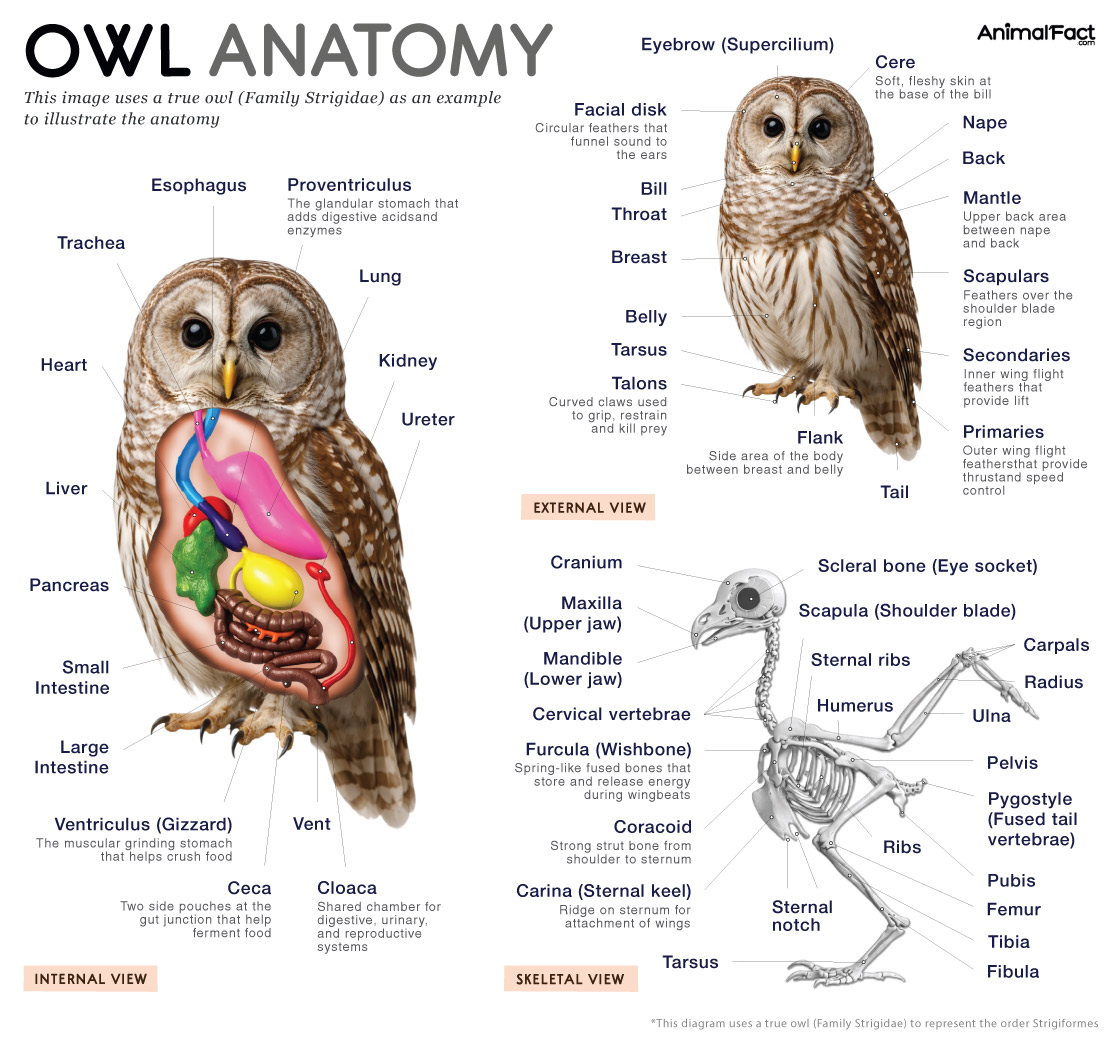
They are easily recognized by a prominent facial disc, a circular arrangement of feathers around each eye. Unlike most birds of prey that have eyes on the sides of their heads, owls have large, forward-facing eyes that provide them with binocular vision. This vision is particularly helpful while hunting in low-light conditions since it gives these birds a remarkable perception of depth.
These birds have exceptional neck mobility, capable of rotating the head up to approximately 270°. Moreover, they are also known for their near-silent flight, made possible by wing feathers with serrated edges and velvety surfaces that reduce noise during flapping of wings.
According to the IOC World Bird List, there are 249 extant species of owls in the world.
Size
The smallest owl of the world, the elf owl (Micrathene whitneyi), is 4.9 to 5.7 in (12.5 to 14.5 cm) long and has a wingspan of about 10.5 in (27 cm). It is also the lightest owl species, weighing only around 1.4 oz (40 g).
The largest and heaviest owls in the world are two similarly sized species: the Eurasian eagle-owl (Bubo bubo) and Blakiston’s fish owl (Ketupa blakistoni). The largest females of these species are 28 in (71 cm) long and have a wingspan of about 75 in (190 cm). They weigh around 148 oz (4.2 kg).
Description
These birds have a large, rounded head with a flat face. Their beak is short, curved, and downward-facing, with a hooked tip that helps them grip, tear, and cut prey. The face is easily recognized by a conspicuous ring of feathers around each eye, called the facial disc. This disc acts like a sound funnel, directing sound waves toward the ears. In many species, such as the barn owl (Tyto alba), the ears are asymmetrically placed, helping them locate the direction of sound more precisely.
Their eyes are fixed in their sockets, so they cannot move them as humans do. Instead, they rotate their head to shift their view, turning the head and neck up to about 270°. This flexibility is enabled by the presence of 14 cervical vertebrae, twice the number found in humans.
More than the beaks, the feet of owls are the most important weapon for catching and killing prey. The tips of the toes are equipped with curved, pointed claws called talons. They are made of keratin, and their sharp, hooked shape helps the owl pierce and lock onto prey.
Plumage
The feathers of owls are large, with many species having soft, serrated edges that reduce air turbulence and minimize sound during flapping of wings. Additionally, the surface of many flight feathers has a velvety texture that absorbs noise.
Their plumage is usually cryptic, having colors and patterns that help them blend into their surroundings. Depending on the habitat, the feathers mimic the tones and textures of tree bark, dry grass, woodland shadows, or snow. Some species, like the long-eared owl (Asio otus), have prominent ear tufts and facial markings for camouflage and visual signaling.
Taxonomy
All 249 extant species of owls are classified under 2 families and 25 genera.
- Family: Tytonidae (Barn owls)
- Genus: Tyto
- Species: Tyto tenebricosa (Greater sooty owl)
- Species: Tyto multipunctata (Lesser sooty owl)
- Species: Tyto inexspectata (Minahasa masked owl)
- Species: Tyto nigrobrunnea (Taliabu masked owl)
- Species: Tyto sororcula (Moluccan masked owl)
- Species: Tyto manusi (Manus masked owl)
- Species: Tyto aurantia (Golden masked owl)
- Species: Tyto novaehollandiae (Australian masked owl)
- Species: Tyto rosenbergii (Sulawesi masked owl)
- Species: Tyto soumagnei (Red owl)
- Species: Tyto alba (Western barn owl)
- Species: Tyto furcata (American barn owl)
- Species: Tyto javanica (Eastern barn owl)
- Species: Tyto deroepstorffi (Andaman masked owl)
- Species: Tyto glaucops (Ashy-faced owl)
- Species: Tyto capensis (African grass owl)
- Species: Tyto longimembris (Eastern grass owl)
- Species: Tyto prigoginei (Itombwe owl)
- Genus: Phodilus
- Species: Phodilus badius (Oriental bay owl)
- Species: Phodilus assimilis (Sri Lanka bay owl)
- Family: Strigidae (True owls)
- Genus: Uroglaux
- Species: Uroglaux dimorpha (Papuan hawk-owl)
- Genus: Ninox
- Species: Ninox rufa (Rufous owl)
- Species: Ninox strenua (Powerful owl)
- Species: Ninox connivens (Barking owl)
- Species: Ninox rudolfi (Sumba boobook)
- Species: Ninox boobook (Australian boobook)
- Species: Ninox rotiensis (Rote boobook)
- Species: Ninox fusca (Timor boobook)
- Species: Ninox plesseni (Alor boobook)
- Species: Ninox leucopsis (Tasmanian boobook)
- Species: Ninox novaeseelandiae (Morepork)
- Species: Ninox japonica (Northern boobook)
- Species: Ninox scutulata (Brown boobook)
- Species: Ninox obscura (Hume’s boobook)
- Species: Ninox randi (Chocolate boobook)
- Species: Ninox affinis (Andaman boobook)
- Species: Ninox philippensis (Luzon boobook)
- Species: Ninox spilocephala (Mindanao boobook)
- Species: Ninox leventisi (Camiguin boobook)
- Species: Ninox reyi (Sulu boobook)
- Species: Ninox rumseyi (Cebu boobook)
- Species: Ninox spilonotus (Romblon boobook)
- Species: Ninox mindorensis (Mindoro boobook)
- Species: Ninox sumbaensis (Least boobook)
- Species: Ninox burhani (Togian boobook)
- Species: Ninox ochracea (Ochre-bellied boobook)
- Species: Ninox ios (Cinnabar boobook)
- Species: Ninox hypogramma (Halmahera boobook)
- Species: Ninox hantu (Buru boobook)
- Species: Ninox squamipila (Seram boobook)
- Species: Ninox forbesi (Tanimbar boobook)
- Species: Ninox natalis (Christmas boobook)
- Species: Ninox meeki (Manus boobook)
- Species: Ninox theomacha (Papuan boobook)
- Species: Ninox punctulata (Speckled boobook)
- Species: Ninox odiosa (New Britain boobook)
- Species: Ninox variegata (New Ireland boobook)
- Genus: Margarobyas
- Species: Margarobyas lawrencii (Bare-legged owl)
- Genus: Taenioptynx
- Species: Taenioptynx brodiei (Collared owlet)
- Species: Taenioptynx sylvaticus (Sunda owlet)
- Genus: Micrathene
- Species: Micrathene whitneyi (Elf owl)
- Genus: Xenoglaux
- Species: Xenoglaux loweryi (Long-whiskered owlet)
- Genus: Aegolius
- Species: Aegolius funereus (Boreal owl)
- Species: Aegolius acadicus (Northern saw-whet owl)
- Species: Aegolius ridgwayi (Unspotted saw-whet owl)
- Species: Aegolius harrisii (Buff-fronted owl)
- Genus: Athene
- Species: Athene blewitti (Forest owlet)
- Species: Athene superciliaris (White-browed owl)
- Species: Athene cunicularia (Burrowing owl)
- Species: Athene noctua (Little owl)
- Species: Athene brama (Spotted owlet)
- Species: Athene jacquinoti (West Solomons owl)
- Species: Athene granti (Guadalcanal owl)
- Species: Athene malaitae (Malaita owl)
- Species: Athene roseoaxillaris (Makira owl)
- Genus: Surnia
- Species: Surnia ulula (Northern hawk-owl)
- Genus: Glaucidium
- Species: Glaucidium passerinum (Eurasian pygmy owl)
- Species: Glaucidium perlatum (Pearl-spotted owlet)
- Species: Glaucidium tephronotum (Red-chested owlet)
- Species: Glaucidium sjostedti (Sjöstedt’s barred owlet)
- Species: Glaucidium cuculoides (Asian barred owlet)
- Species: Glaucidium castanopterum (Javan owlet)
- Species: Glaucidium radiatum (Jungle owlet)
- Species: Glaucidium castanotum (Chestnut-backed owlet)
- Species: Glaucidium capense (African barred owlet)
- Species: Glaucidium albertinum (Albertine owlet)
- Species: Glaucidium californicum (Northern pygmy owl)
- Species: Glaucidium gnoma (Mountain pygmy owl)
- Species: Glaucidium hoskinsii (Baja pygmy owl)
- Species: Glaucidium cobanense (Guatemalan pygmy owl)
- Species: Glaucidium costaricanum (Costa Rican pygmy owl)
- Species: Glaucidium nubicola (Cloud-forest pygmy owl)
- Species: Glaucidium jardinii (Andean pygmy owl)
- Species: Glaucidium bolivianum (Yungas pygmy owl)
- Species: Glaucidium palmarum (Colima pygmy owl)
- Species: Glaucidium sanchezi (Tamaulipas pygmy owl)
- Species: Glaucidium griseiceps (Central American pygmy owl)
- Species: Glaucidium parkeri (Subtropical pygmy owl)
- Species: Glaucidium hardyi (Amazonian pygmy owl)
- Species: Glaucidium minutissimum (East Brazilian pygmy owl)
- Species: Glaucidium mooreorum (Pernambuco pygmy owl)
- Species: Glaucidium brasilianum (Ferruginous pygmy owl)
- Species: Glaucidium peruanum (Pacific pygmy owl)
- Species: Glaucidium nana (Austral pygmy owl)
- Species: Glaucidium siju (Cuban pygmy owl)
- Genus: Otus
- Species: Otus gurneyi (Giant scops owl)
- Species: Otus sagittatus (White-fronted scops owl)
- Species: Otus rufescens (Reddish scops owl)
- Species: Otus thilohoffmanni (Serendib scops owl)
- Species: Otus icterorhynchus (Sandy scops owl)
- Species: Otus ireneae (Sokoke scops owl)
- Species: Otus balli (Andaman scops owl)
- Species: Otus alfredi (Flores scops owl)
- Species: Otus spilocephalus (Mountain scops owl)
- Species: Otus angelinae (Javan scops owl)
- Species: Otus mirus (Mindanao scops owl)
- Species: Otus longicornis (Luzon scops owl)
- Species: Otus mindorensis (Mindoro scops owl)
- Species: Otus madagascariensis (Torotoroka scops owl)
- Species: Otus rutilus (Rainforest scops owl)
- Species: Otus mayottensis (Mayotte scops owl)
- Species: Otus pauliani (Karthala scops owl)
- Species: Otus capnodes (Anjouan scops owl)
- Species: Otus moheliensis (Moheli scops owl)
- Species: Otus brucei (Pallid scops owl)
- Species: Otus pamelae (Arabian scops owl)
- Species: Otus scops (Eurasian scops owl)
- Species: Otus cyprius (Cyprus scops owl)
- Species: Otus bikegila (Principe scops owl)
- Species: Otus pembaensis (Pemba scops owl)
- Species: Otus hartlaubi (Sao Tome scops owl)
- Species: Otus senegalensis (African scops owl)
- Species: Otus feae (Annobon scops owl)
- Species: Otus socotranus (Socotra scops owl)
- Species: Otus sunia (Oriental scops owl)
- Species: Otus elegans (Ryukyu scops owl)
- Species: Otus magicus (Moluccan scops owl)
- Species: Otus tempestatis (Wetar scops owl)
- Species: Otus sulaensis (Sula scops owl)
- Species: Otus beccarii (Biak scops owl)
- Species: Otus manadensis (Sulawesi scops owl)
- Species: Otus mendeni (Banggai scops owl)
- Species: Otus siaoensis (Siau scops owl)
- Species: Otus collari (Sangihe scops owl)
- Species: Otus mantananensis (Mantanani scops owl)
- Species: Otus insularis (Seychelles scops owl)
- Species: Otus alius (Nicobar scops owl)
- Species: Otus umbra (Simeulue scops owl)
- Species: Otus enganensis (Enggano scops owl)
- Species: Otus mentawi (Mentawai scops owl)
- Species: Otus brookii (Rajah scops owl)
- Species: Otus bakkamoena (Indian scops owl)
- Species: Otus lettia (Collared scops owl)
- Species: Otus semitorques (Japanese scops owl)
- Species: Otus lempiji (Sunda scops owl)
- Species: Otus megalotis (Philippine scops owl)
- Species: Otus nigrorum (Negros scops owl)
- Species: Otus everetti (Everett’s scops owl)
- Species: Otus fuliginosus (Palawan scops owl)
- Species: Otus silvicola (Wallace’s scops owl)
- Species: Otus jolandae (Rinjani scops owl)
- Species: Otus podarginus (Palau scops owl)
- Genus: Ptilopsis
- Species: Ptilopsis leucotis (Northern white-faced owl)
- Species: Ptilopsis granti (Southern white-faced owl)
- Genus: Asio
- Species: Asio grammicus (Jamaican owl)
- Species: Asio clamator (Striped owl)
- Species: Asio otus (Long-eared owl)
- Species: Asio abyssinicus (Abyssinian owl)
- Species: Asio madagascariensis (Madagascar owl)
- Species: Asio stygius (Stygian owl)
- Species: Asio flammeus (Short-eared owl)
- Species: Asio capensis (Marsh owl)
- Species: Asio solomonensis (Fearful owl)
- Genus: Jubula
- Species: Jubula lettii (Maned owl)
- Genus: Bubo
- Species: Bubo scandiacus (Snowy owl)
- Species: Bubo virginianus (Great horned owl)
- Species: Bubo magellanicus (Lesser horned owl)
- Species: Bubo bubo (Eurasian eagle-owl)
- Species: Bubo bengalensis (Indian eagle-owl)
- Species: Bubo ascalaphus (Pharaoh eagle-owl)
- Species: Bubo capensis (Cape eagle-owl)
- Species: Bubo milesi (Arabian eagle-owl)
- Species: Bubo cinerascens (Greyish eagle-owl)
- Species: Bubo africanus (Spotted eagle-owl)
- Genus: Ketupa
- Species: Ketupa poensis (Fraser’s eagle-owl)
- Species: Ketupa leucosticta (Akun eagle-owl)
- Species: Ketupa lactea (Verreaux’s eagle-owl)
- Species: Ketupa shelleyi (Shelley’s eagle-owl)
- Species: Ketupa blakistoni (Blakiston’s fish owl)
- Species: Ketupa zeylonensis (Brown fish owl)
- Species: Ketupa flavipes (Tawny fish owl)
- Species: Ketupa ketupu (Buffy fish owl)
- Species: Ketupa sumatrana (Barred eagle-owl)
- Species: Ketupa nipalensis (Spot-bellied eagle-owl)
- Species: Ketupa coromanda (Dusky eagle-owl)
- Species: Ketupa philippensis (Philippine eagle-owl)
- Genus: Scotopelia
- Species: Scotopelia peli (Pel’s fishing owl)
- Species: Scotopelia ussheri (Rufous fishing owl)
- Species: Scotopelia bouvieri (Vermiculated fishing owl)
- Genus: Psiloscops
- Species: Psiloscops flammeolus (Flammulated owl)
- Genus: Gymnasio
- Species: Gymnasio nudipes (Puerto Rican owl)
- Genus: Megascops
- Species: Megascops trichopsis (Whiskered screech owl)
- Species: Megascops clarkii (Bare-shanked screech owl)
- Species: Megascops albogularis (White-throated screech owl)
- Species: Megascops choliba (Tropical screech owl)
- Species: Megascops barbarus (Bearded screech owl)
- Species: Megascops cooperi (Pacific screech owl)
- Species: Megascops kennicottii (Western screech owl)
- Species: Megascops asio (Eastern screech owl)
- Species: Megascops seductus (Balsas screech owl)
- Species: Megascops guatemalae (Middle American screech owl)
- Species: Megascops koepckeae (Koepcke’s screech owl)
- Species: Megascops ingens (Rufescent screech owl)
- Species: Megascops petersoni (Cinnamon screech owl)
- Species: Megascops marshalli (Cloud-forest screech owl)
- Species: Megascops hoyi (Yungas screech owl)
- Species: Megascops centralis (Choco screech owl)
- Species: Megascops roraimae (Foothill screech owl)
- Species: Megascops sanctaecatarinae (Long-tufted screech owl)
- Species: Megascops gilesi (Santa Marta screech owl)
- Species: Megascops roboratus (West Peruvian screech owl)
- Species: Megascops watsonii (Tawny-bellied screech owl)
- Species: Megascops atricapilla (Black-capped screech owl)
- Genus: Pulsatrix
- Species: Pulsatrix perspicillata (Spectacled owl)
- Species: Pulsatrix koeniswaldiana (Tawny-browed owl)
- Species: Pulsatrix melanota (Band-bellied owl)
- Genus: Lophostrix
- Species: Lophostrix cristata (Crested owl)
- Genus: Strix
- Species: Strix seloputo (Spotted wood owl)
- Species: Strix ocellata (Mottled wood owl)
- Species: Strix leptogrammica (Brown wood owl)
- Species: Strix aluco (Tawny owl)
- Species: Strix mauritanica (Maghreb owl)
- Species: Strix nivicolum (Himalayan owl)
- Species: Strix hadorami (Desert owl)
- Species: Strix butleri (Omani owl)
- Species: Strix occidentalis (Spotted owl)
- Species: Strix varia (Barred owl)
- Species: Strix sartorii (Cinereous owl)
- Species: Strix fulvescens (Fulvous owl)
- Species: Strix hylophila (Rusty-barred owl)
- Species: Strix chacoensis (Chaco owl)
- Species: Strix rufipes (Rufous-legged owl)
- Species: Strix uralensis (Ural owl)
- Species: Strix nebulosa (Great grey owl)
- Species: Strix woodfordii (African wood owl)
- Species: Strix virgata (Mottled owl)
- Species: Strix nigrolineata (Black-and-white owl)
- Species: Strix huhula (Black-banded owl)
- Species: Strix albitarsis (Rufous-banded owl)
According to recent phylogenetic studies, the order Strigiformes is most closely related to the group Accipitrimorphae, which includes hawks and their relatives, as well as New World vultures.[1]
Distribution and Habitat
Owls are found on all continents except Antarctica and a few remote oceanic islands, such as the Pitcairn Islands (South Pacific) and Tristan da Cunha (South Atlantic), which have no native owl populations.[2][3]
These birds occupy most terrestrial habitats where they can find prey and safe roosting or nesting sites. For example, they live in forests and woodlands, open landscapes such as grasslands, and wet habitats such as marshes and reedbeds. Some species, such as the elf owl (Micrathene whitneyi), inhabit deserts, whereas the snowy owl (Bubo scandiacus) mainly inhabits the cold Arctic tundra.[4][5]
Diet
Being birds of prey, owls have a carnivorous diet. Large owls, such as the great horned owl (Bubo virginianus), primarily eat hares and rabbits, but they also take larger birds, like grouse and ducks.[6] In fact, this species has been recorded to supplement its diet with snakes, including venomous species.[7]
Medium-sized owls feed mostly on rodents, including mice, voles, and rats. Small owls mainly eat insects (such as beetles, moths, and grasshoppers), as well as small lizards, frogs, and mice.
Lifespan
Like most animals, an owl’s lifespan depends on its species and whether it lives in the wild or in captivity. Barn owls typically live 4 to 9 years in the wild, but can survive up to 15 years in captivity. The great horned owl usually lives around 13 years in the wild, but it has been recorded living up to 50 years in captivity.[8] The Eurasian eagle owl (Bubo bubo), likely the longest living owl species, averages 10 to 20 years in the wild, with some individuals reaching up to 60 years in captivity.[9]
Reproduction and Life Cycle
These birds reproduce sexually, with males attracting potential mates with calls, display flights, and often by bringing prey as gifts to the female. Most species are seasonally monogamous, though in some, like tawny owls, pairs remain together for life or multiple years.
Once a pair forms, they usually search for tree cavities, cliff ledges, or even nests abandoned by other birds to use as their own nesting sites. During mating, the male transfers his sperm to the female by a brief ‘cloacal kiss,’ and fertilization eventually occurs internally.
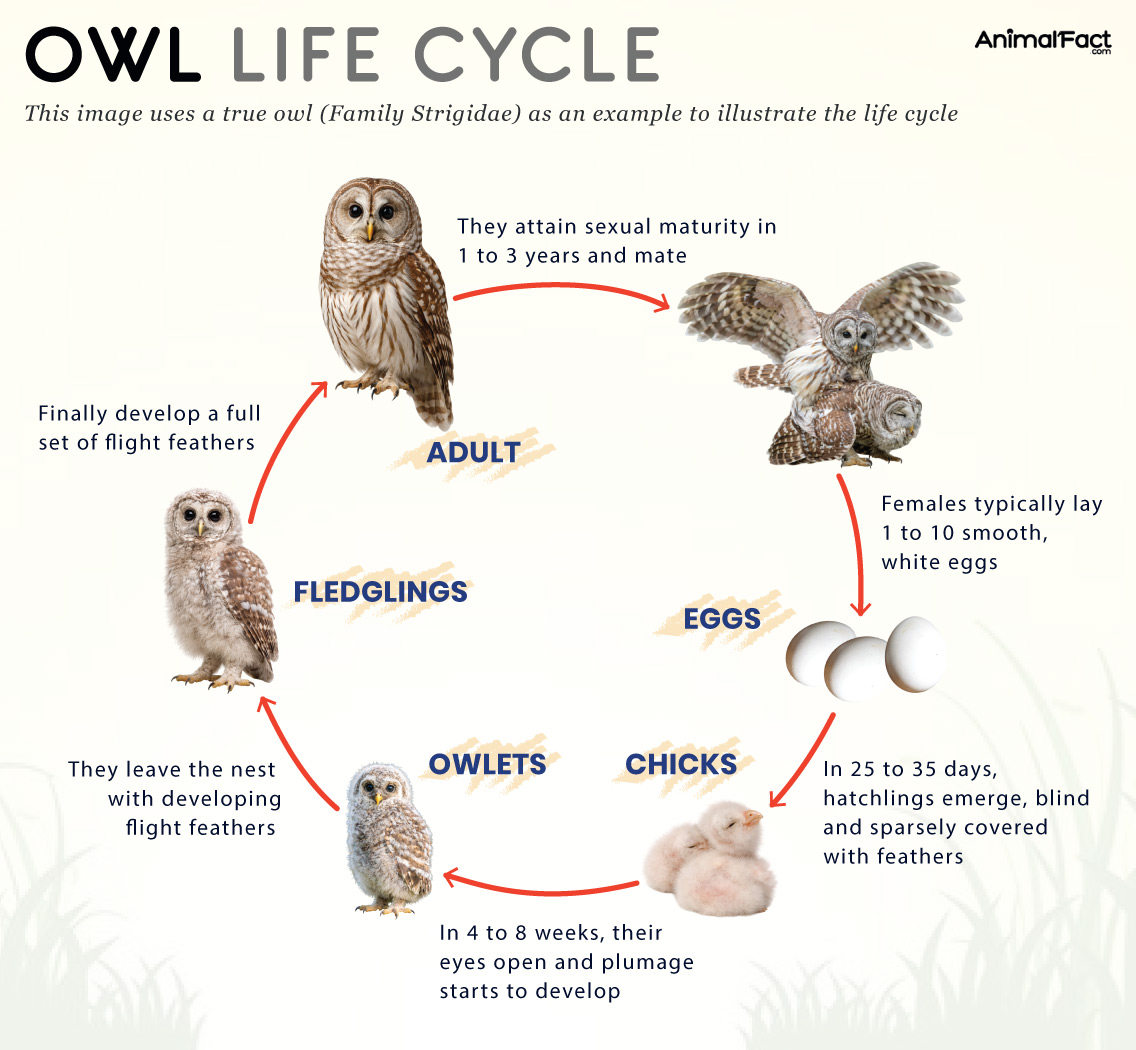
Females typically lay 1 to 10 smooth, white eggs. In 25 to 35 days, hatchlings or chicks emerge, blind and sparsely covered with feathers. With time, in 4 to 8 weeks, their eyes open and plumage starts to develop, a stage when they are called owlets. These owlets gradually leave the nest as fledglings with developing flight feathers but remain dependent on parents. The fledglings develop a full set of flight feathers and, in 1 to 3 years, become sexually mature.
Predators
Although owls are apex predators with few enemies, they are vulnerable to larger birds of prey, such as eagles and hawks. Occasionally, falcons, too, target young owls or smaller species.
Some species, such as the great horned owl, are known to kill and sometimes prey on smaller owl species. In rare cases, they have also been reported to cannibalize members of their own species.[10]
Many mammals, including foxes, coyotes, raccoons, martens, bobcats, and wildcats, target owl nests for eggs or fledglings. In fact, several snake species, such as garter snakes, frequently raid nests for eggs and owlets, especially in ground-nesting species.