Nematodes, commonly called roundworms or eelworms, are unsegmented, cylindrical invertebrates that belong to the phylum Nematoda. They are among the most widespread and abundant animal groups on Earth. These animals occur in nearly every habitat, including soil, freshwater, and marine environments, where they often exist in very high densities, especially in topsoil and sediments. Scientists have described more than 25,000 species, most of which are free-living and feed on bacteria, fungi, and other microbes. However, many species are parasitic, infecting plants, animals, and humans and causing major economic losses and health impacts.
The classification of nematodes has long been uncertain, as many nematode species remain poorly studied. In 1933, Chitwood and Chitwood proposed one of the earliest classification systems, dividing nematodes into two classes, Aphasmida and Phasmida, which were later renamed into Adenophorea and Secernentea, respectively.
Initial studies of incomplete DNA sequences suggested that nematodes could be arranged into five major clades:
Later, in 2022, a new classification of nematodes based on current molecular, developmental, and morphological evidence was presented by M. Hodda. Under this classification, there are 3 classes and 8 subclasses.
These invertebrates have a cosmopolitan distribution, being present in every part of the lithosphere, from mountains to oceanic trenches.
Around 4.4 × 10²⁰ nematodes inhabit the topsoil of the Earth. Researchers have recorded nematodes at a depth of 11,811 ft (3.6 km) in an underground borehole in the Tau Tona gold mine, South Africa.[1]
They occur in both freshwater and marine environments, and, in deep-sea benthic sediments, nematodes can account for over 90% of multicellular animals by individual abundance.[2]
Around 62% of nematodes parasitize almost every living organism, including humans, domestic and wild animals, insects, and plants.[3] They occupy highly specific microhabitats within the host. For example:
Entomopathogenic Nematode (EPN)
These are a group of nematodes (mainly the genera Steinernema and Heterorhabditis) that infect and kill insect pests, typically through an association with symbiotic bacteria. Their infective juvenile (IJ) stage enters an insect host, releases its bacteria into its body cavity, and the bacteria then rapidly kill the host. One of the most well-known EPNs, Steinernema carpocapsae, commonly infects lepidopteran larvae such as those of black cutworm (Agrotis ipsilon). Its juveniles enter the insect through openings like the mouth, anus, or spiracles, releasing its symbiotic bacterium Xenorhabdus, which eventually kills the host.[6] It is due to this parasitic trait that EPNs are widely employed as biological control agents.
The diet of nematodes varies depending on whether they are free-living or parasitic.
Free-living nematodes typically feed on resources available in the environment, such as:
Parasitic nematodes, in contrast, live off the resources of their host, such as:
Although most nematodes reproduce sexually, asexual reproduction is also observed in some groups.
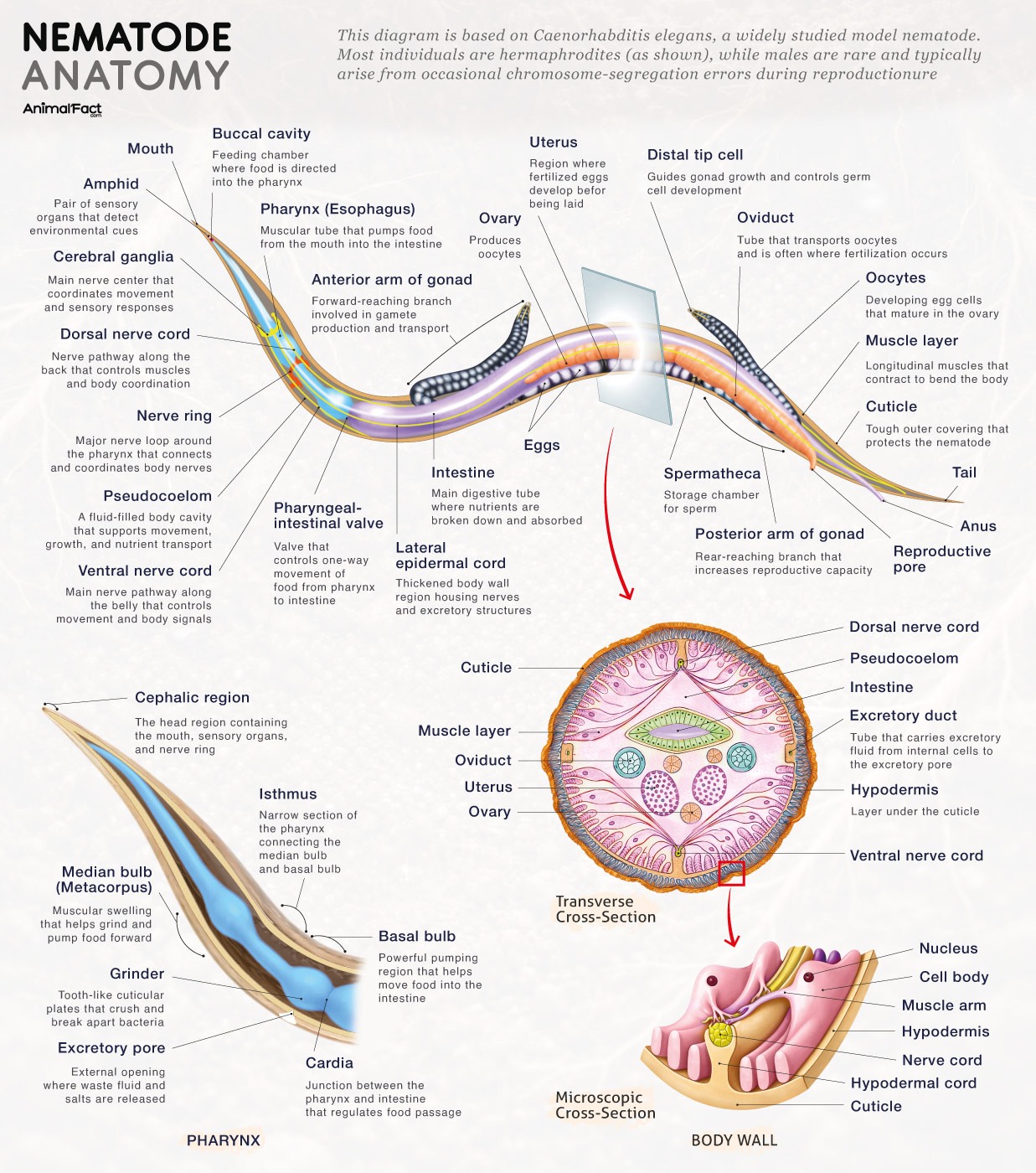
Most nematodes are dioecious, with separate males and females. Males are usually smaller and often have a bent or fan-shaped tail with sclerotized spicules for sperm transfer. Their amoeboid sperm crawl into the female’s reproductive tract and are stored in the spermatheca until fertilization. This sexual reproduction, involving the fusion of male and female gametes to form a diploid zygote, is called amphimixis.
There are 2 types:
Androdioecy
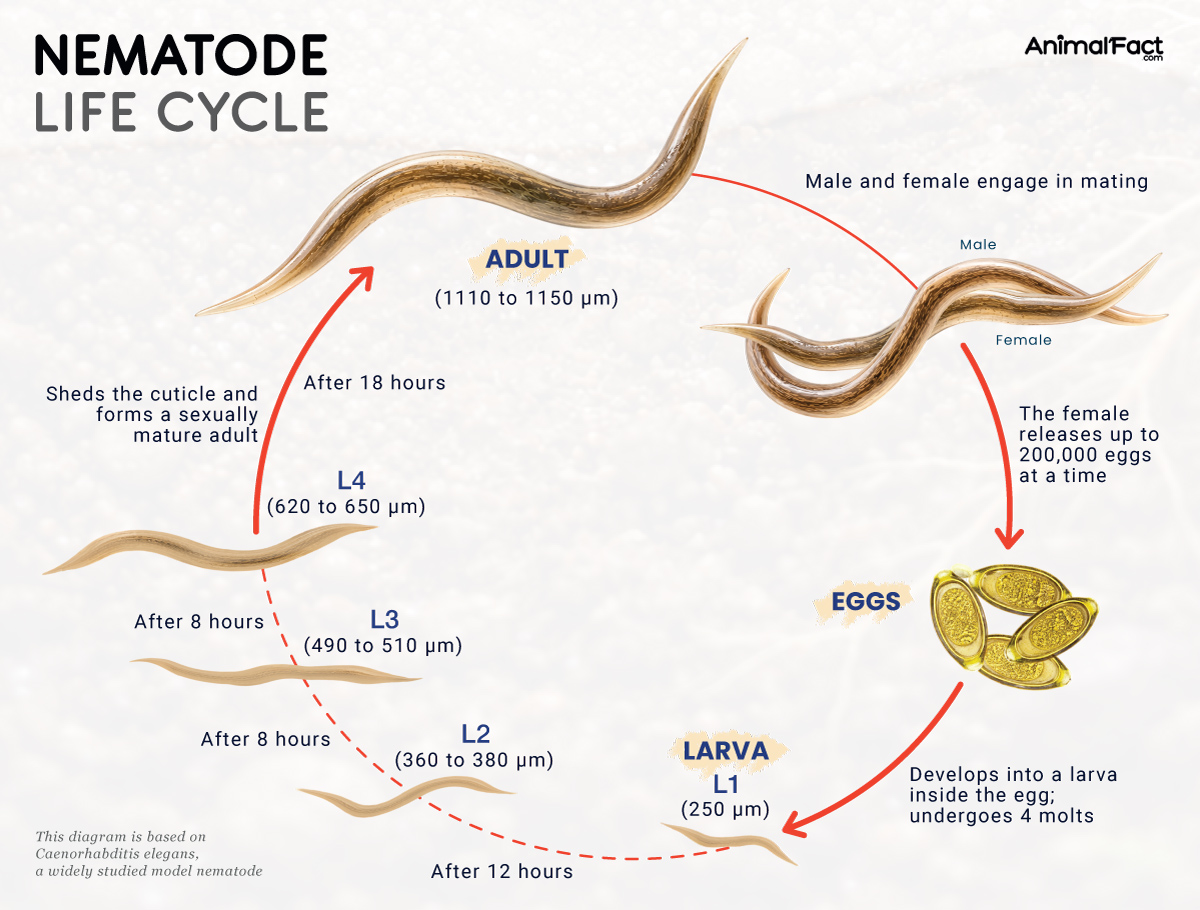
In species like Caenorhabditis elegans, populations are mostly hermaphrodites, with only a small number of males (which appear due to occasional errors during chromosome separation). In hermaphrodites, the gonad produces sperm first and stores it in the spermatheca, then later produces eggs that are fertilized by this stored sperm (self-fertilization).
If a male mates with a hermaphrodite, he transfers sperm that eventually fertilize the eggs (outcrossing).
In this mode of reproduction, the offspring develop with no genetic contribution from a male.
Interesting Fact
In some nematodes, such as Heterorhabditis, fertilized eggs may be retained in the uterus when resources are scarce. The eggs then hatch inside the mother, and the juveniles develop within her body. As they grow, they damage the mother’s tissues, leading to her death, and the juveniles may feed on her body to gain nutrients for early growth. This survival strategy is called endotokia matricida.[8]
Welcome to AnimalFact - your go-to source for fascinating insights into the amazing world of animals!