


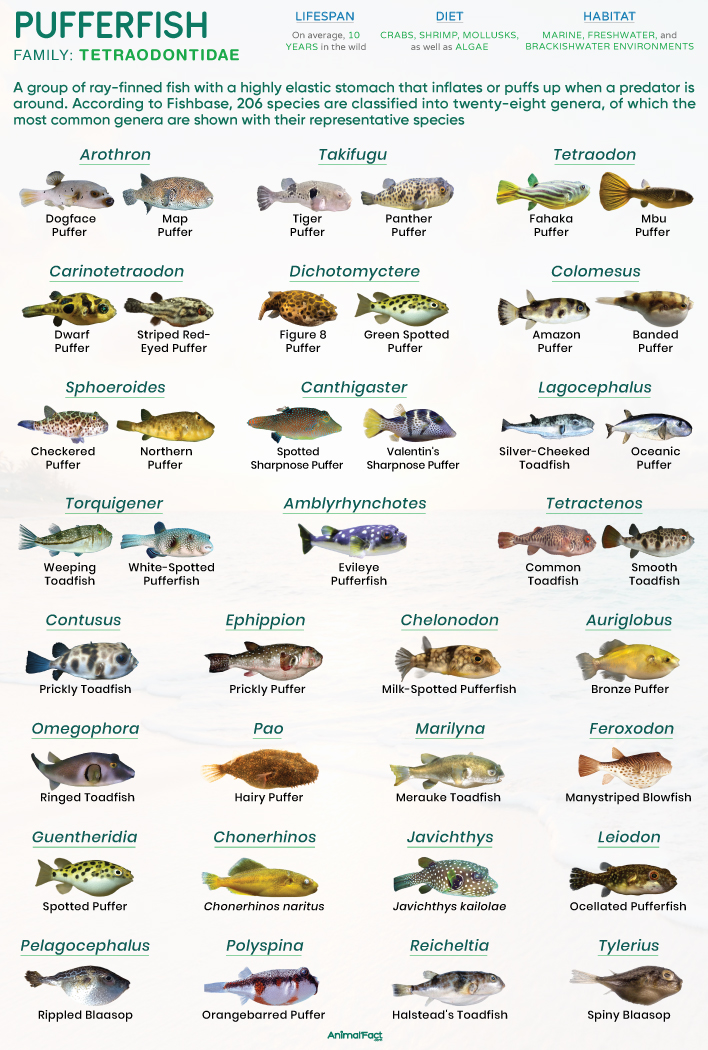
Pufferfish are a group of ray-finned fish that constitute the family Tetraodontidae within the order Tetraodontiformes. They are also commonly addressed with other names, such as puffers, balloonfish, blowfish, blowers, blowies, bubblefish, globefish, swellfish, and toadfish, among others.
These fish are noted for their distinctive defensive adaptation: a highly elastic and expandable stomach that allows them to inflate or puff up (thus the common name) by drawing in water whenever a potential predator approaches. They are also equipped with a set of four fused, beak-like teeth, which give the group its scientific name (‘tetra,’ meaning four, and ‘odous,’ meaning tooth). These teeth help pufferfish to break open the hard shells of invertebrates and feed on them.
Another defining feature of many pufferfish species is the presence of tetrodotoxin, a potent neurotoxin that makes the fish dangerous to consume.
Depending on the species, these fish range from less than 1 in (2.5 cm) to as much as 3 ft (90 cm) in length.[1]
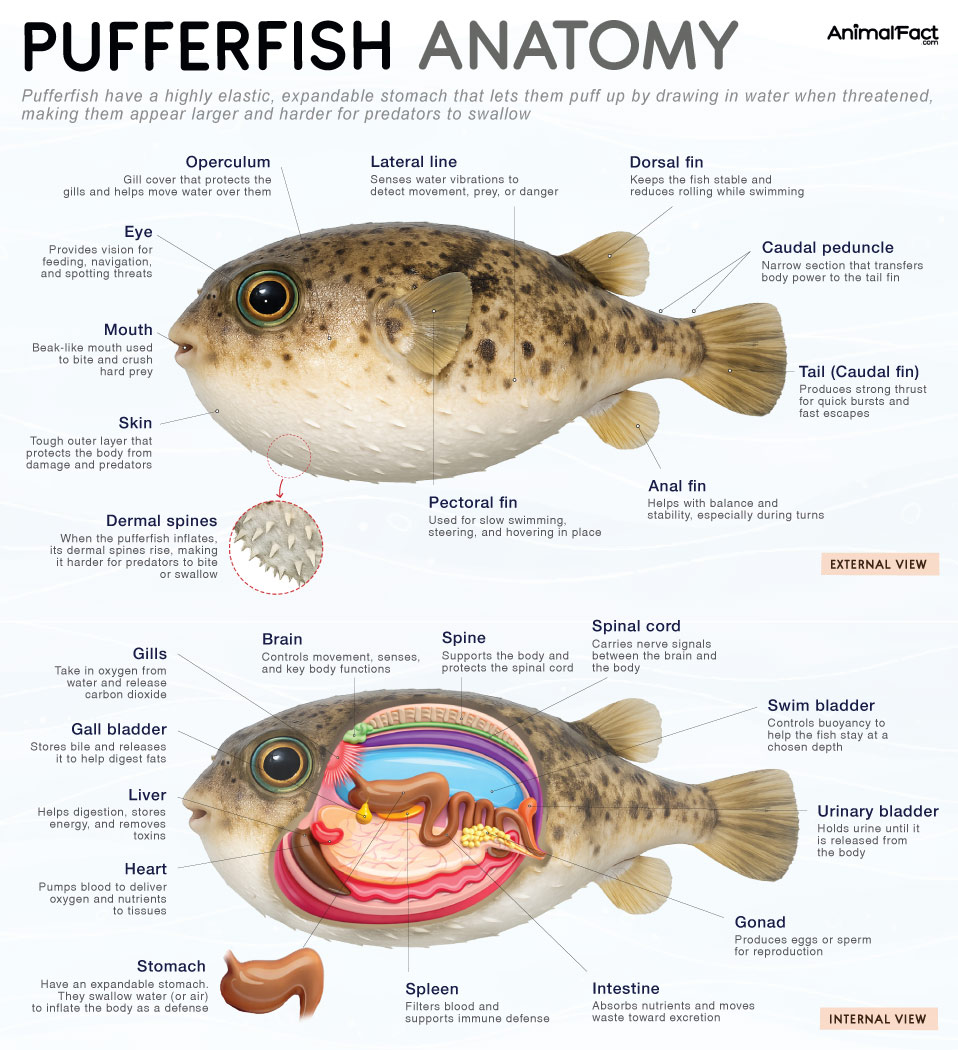
Pufferfish have an oval body, which takes on a globular shape when the animal inflates itself. They lack ribs and pelvic fins, providing sufficient room for easy inflation.
Their mouth is usually small and forward-facing, enhancing their beak-like dental structure. The upper and lower tooth arches are each fused, with a distinct midline in between.
Instead of smooth scales found in most fish, pufferfish have hard, pointed dermal spines embedded in their skin. Some species, such as the starry puffer (Arothron stellatus), have these spines covering almost the entire body, while in others, the head region may be spineless.
Unlike their close relatives, the porcupinefish (family Diodontidae), which have large, visible spines, pufferfish have short spines that, in most species, are visible only when the fish is inflated.
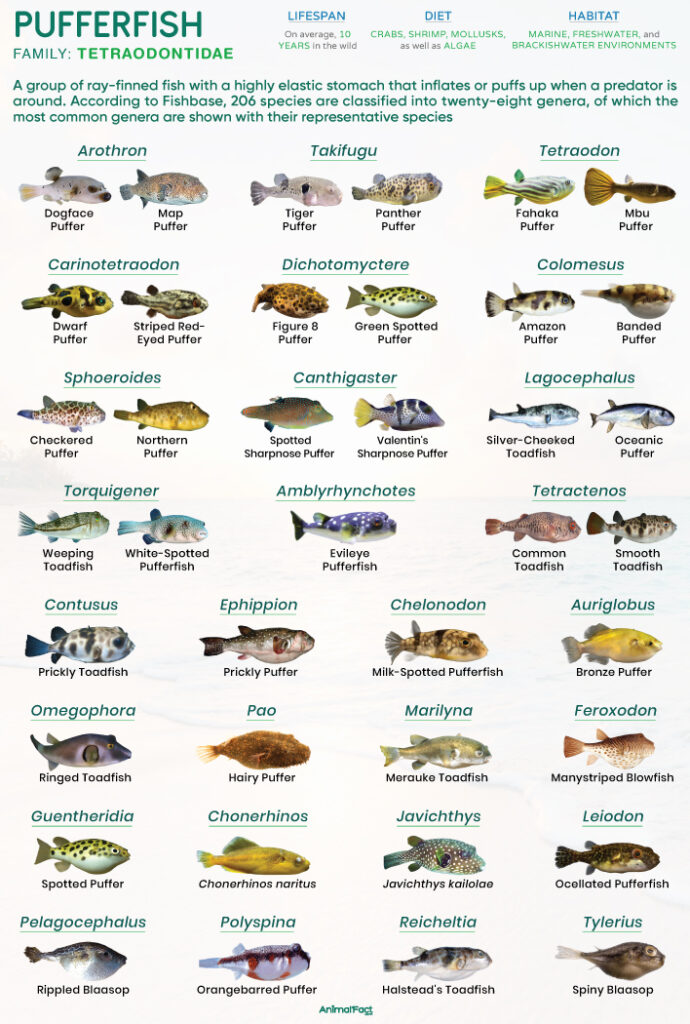
According to Fishbase, the family comprises 206 species classified into 28 genera.
The lineage of pufferfish is estimated to have diverged from that of porcupinefish between 89 and 138 million years ago. The oldest pufferfish, belonging to the genus Eotetraodon, dates back to the Middle Eocene Epoch (between 48 and 41 million years ago).
These fish are widely distributed across the tropical and subtropical regions of the world, with some species extending into temperate waters. However, they are absent from the polar waters.
Depending on the species, pufferfish are found in marine, brackish waters, or freshwater environments.
While most species inhabit marine or brackish waters, approximately 35 species are found in freshwater habitats. These freshwater species occur in geographically isolated tropical areas across South America (Colomesus asellus and Colomesus tocantinensis), Africa (six species of the genus Tetraodon), and Southeast Asia (members of the genera Auriglobus, Carinotetraodon, Dichotomyctere, Leiodon, and Pao).[2][3]
Most pufferfish have an omnivorous diet that primarily includes small invertebrates such as crabs, shrimp, and small lobsters, as well as mollusks like snails, clams, and mussels. They also consume algae as part of their diet. When their preferred food sources are scarce, they may feed on other marine life such as starfish, sea urchins, sponges, and coral polyps.[4]
They propel themselves by coordinating their pectoral, dorsal, anal, and caudal fins, while the caudal fin serves as the primary rudder. This caudal fin also helps them attain sudden bursts of speed, particularly when predators are around.
When their primary defense, flight, fails, pufferfish switch to a secondary strategy. They rapidly fill their elastic stomachs with water until they expand into giant, spiky balloons capable of deterring predators. Even if a predator manages to catch the pufferfish before it inflates, ingesting it often results in poisoning due to the toxic tetrodotoxin, found mostly in the ovaries and liver, with smaller amounts present in the intestines, skin, and muscles.
Depending on the species, the lifespan of these fish ranges from 3 to 20 years, with an average of 10 years.[5]
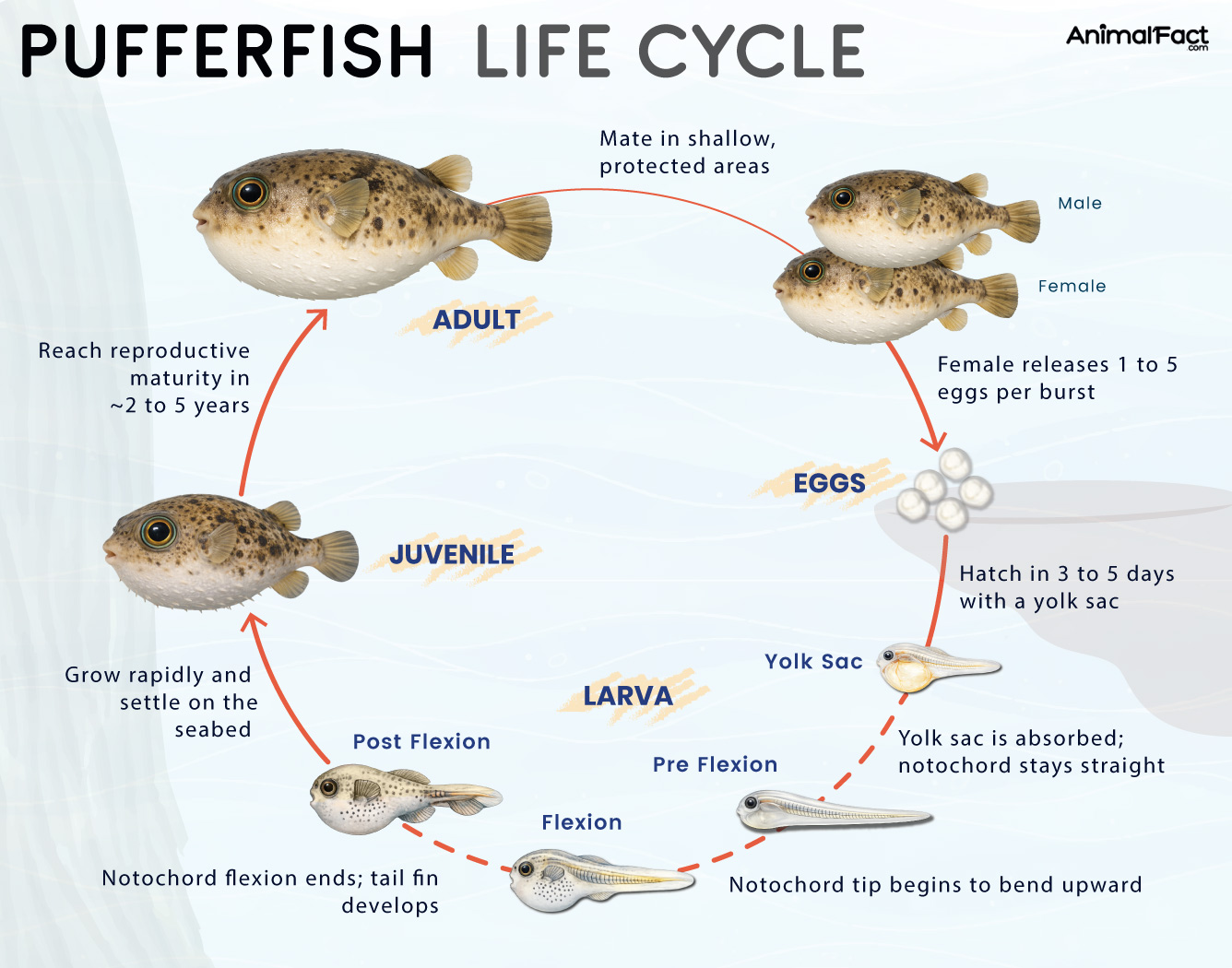
Depending on whether they inhabit the open ocean, brackish estuaries, or freshwater habitats, pufferfish adopt different reproductive strategies. In marine species, the males nudge or push the females toward the water’s surface. Both sexes release their gametes into the water, where external fertilization occurs.
In freshwater members, such as dwarf puffers, the males follow and court females, displaying specialized crests and keels. Once the female accepts the male, she leads him into sheltered areas, where they release their gametes.
Brackishwater species may spawn in coastal bays, or they may migrate upriver and adopt breeding behaviors more typical of freshwater species, depending on how far inland they have moved.
The fertilized eggs, which are spherical and buoyant, hatch into larvae within 3 to 5 days. These tiny, transparent larvae are short-lived, and they rapidly develop fins, already resembling a miniature adult pufferfish. They begin to settle on the seabed or vegetation, transforming into juveniles (fry).
The juveniles possess a functional mouth and eyes, and they begin feeding on hard-shelled prey, eventually developing into adults.
These fish have very few predators because of their toxicity and ability to inflate. However, some sharks, particularly tiger sharks, are resistant to pufferfish toxins and do consume them. Some large predatory fish, such as lizardfish and triggerfish, may also feed on them, usually catching them before they inflate. Additionally, certain marine birds, like cormorants, may prey on these fish.
A few sea snakes are also resistant to the toxins and therefore feed on pufferfish.
Welcome to AnimalFact - your go-to source for fascinating insights into the amazing world of animals!

