Seals are typically marine, semi-aquatic mammals that belong to the parvorder Pinnipedia. Although Pinnipedia comprises three families, the term ‘seals’ is used specifically for members of two groups: the true seals of the family Phocidae and the eared seals of the family Otariidae. The third family, Odobenidae, contains only one extant species, the walrus (Odobenus rosmarus), which is not considered a seal. Thus, all pinnipeds other than the walrus are classified as seals.
The name ‘pinniped’ comes from the Latin words pinna (fin) and pedis (foot), a reference to their limbs, which are modified into flippers that function as fins during swimming. They also have a thick layer of insulating blubber that helps them tolerate low temperatures in the oceans.
There are 33 extant species of seals, with most living in cold, temperate waters.
The smallest seals include the Baikal seal (Pusa sibirica), which is 3.7 to 4.7 ft (1.1 to 1.4 m) long, and the ringed seal (Pusa hispida), which is 5 ft (1.5 m) long on average. In contrast, the largest seal, the southern elephant seal (Mirounga leonina), which is also the largest extant non-cetacean marine mammal, averages around 16 ft (5 m). The males of this species weigh between 3,300 and 8,200 lb (1,500 and 3,700 kg).[1][2]
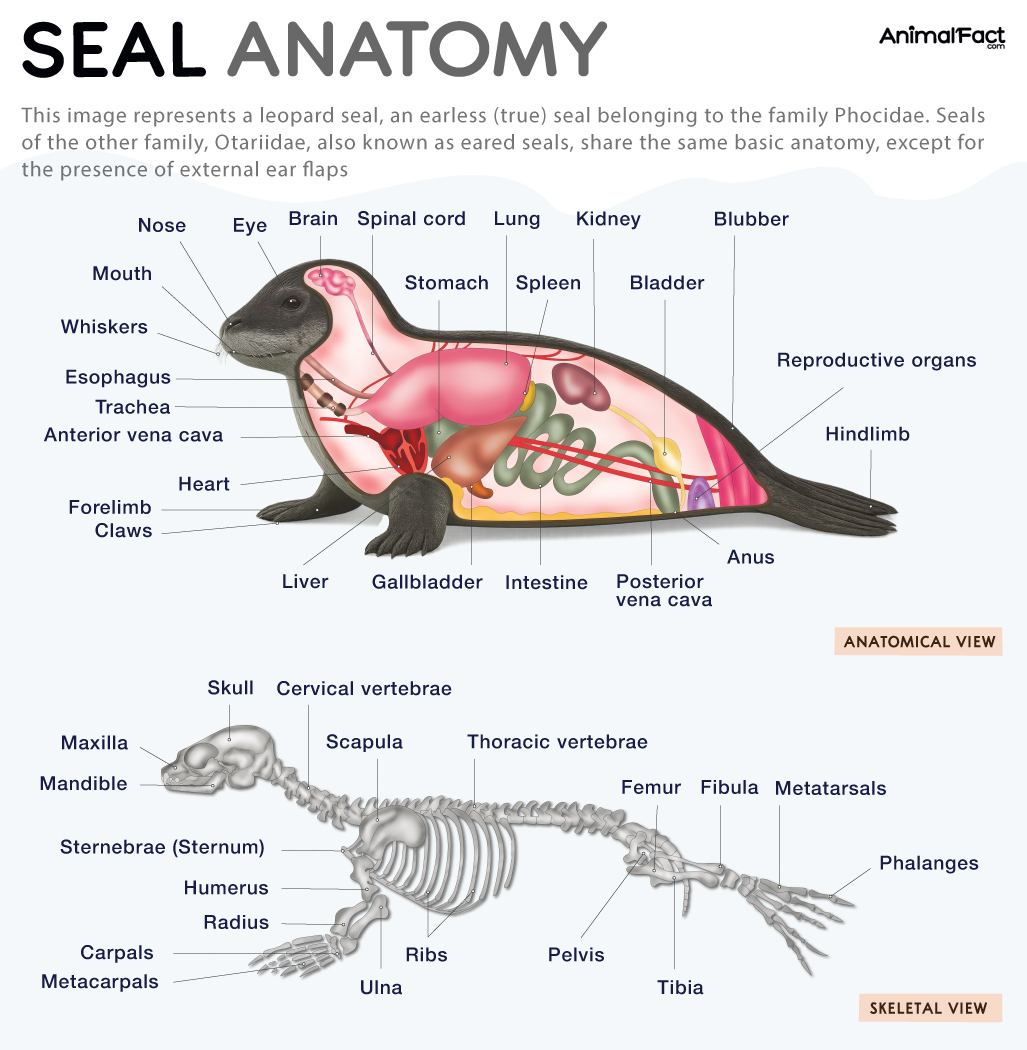
All seals have a streamlined, torpedo-shaped body with two pairs of flippers, the foreflippers and the hindflippers. While eared seals have well-developed, elongated fore-flippers, earless seals have shorter, less robust fore-flippers. Moreover, eared seals possess external ear flaps (pinnae), whereas earless seals lack them altogether and instead have smooth-sided heads with small auditory openings.
They are covered by a thick coat of fur, though some species, particularly sea lions (subfamily Otariinae), tend to be less densely furred than land mammals. In ice-breeding species, pups are born with a thick layer of body hair (lanugo) that traps sunlight and helps retain heat.
Beneath the coat of fur, seals possess a layer of subcutaneous fat, or blubber, which provides insulation and also serves as an energy reserve when the animal fasts.
These mammals also possess highly sensitive hairs or whiskers (vibrissae) around the snout, which allow them to detect subtle vibrations underwater. In some species, such as the Antarctic fur seal, these whiskers reach lengths of around 16 in (41 cm).
Seals have relatively large eyes compared to their body size, adapted for clear vision both underwater and in the air. They possess a spherical lens and a flattened central cornea, which together allow consistent refraction in both environments. A reflective layer behind the retina, known as the tapetum lucidum, enhances vision in low light, enabling seals to see well in deep waters. Like those of many other mammals, their eyes possess a protective nictitating membrane and a lubricating lacrimal gland.
In both eared and earless seals, the middle and inner ear structures are specialized for underwater hearing. The ear bones are thickened, allowing efficient sound transmission in water while preventing damage from pressure changes during deep dives. Some species, such as harbor seals, respond to sounds ranging from 1 to 180 kHz with a peak sensitivity of 32 kHz.[3]
The 33 extant species of seals are classified into 2 families: Phocidae and Otariidae. The latter is grouped under a superfamily, Otarioidea, along with Odobenidae, the family that comprises only one extant species, the walrus.[4]
Seals have descended from a single ancestor, with the major split between the earless and eared forms occurring around 25 million years ago. By the Late Oligocene–Early Miocene Epoch (approximately 23 to 25 million years ago), the earliest true earless seals, such as Noriphoca gaudini from Italy, had already appeared. Around 20 million years ago, the eared seals and walruses diverged.
By the Middle Miocene (around 15 million years ago), earless seals had further split into their two living subfamilies, the Monachinae and Phocinae, which are represented in the fossil record by early forms such as Monotherium (Monachinae) and Leptophoca (Phocinae) from North America. Both groups likely originated in the North Atlantic, reaching the Pacific through the Central American Seaway.
Eared seals first appeared around 15 to 17 million years ago, with early species, such as Eotaria crypta, and later genera like Pithanotaria and Thalassoleon emerging around 11 million years ago in the North Pacific.
Through the Late Miocene and into the Pliocene Epoch, eared seals expanded into the Southern Hemisphere, while true seals continued to diversify globally.
These mammals are found in both the Northern and Southern Hemispheres, mainly in cold, temperate waters. They typically require water temperatures lower than 68 °F (20 °C) to thrive.
In the Arctic and subarctic regions, ice-dependent species, such as ringed and harp seals, live around sea ice. Along the North Atlantic and North Pacific coasts, species such as harbor, grey, ribbon, and spotted seals inhabit coastal waters. Similarly, in the Southern Hemisphere, elephant, Weddell, crabeater, leopard, and fur seals are found around Antarctica and nearby subantarctic islands.
Monk seals are found in relatively warmer waters, such as the eastern Mediterranean, parts of the North Atlantic, and the Hawaiian Islands.
Although these mammals spend most of their lives in the water, most species haul out onto land or ice to mate, give birth, molt, or avoid ocean predators. Those in non-polar waters haul out onto rocky shores, sandy and pebble beaches, sandbanks, and tidal flats.
Only two species, the Caspian seal and the Baikal seal, are found in large landlocked bodies of water. In fact, the Baikal seal is the only species that is found exclusively in a freshwater environment.[5]
All seals are predatory carnivores that typically feed on fish and a range of invertebrates, including squid, octopus, clams, mussels, krill, shrimp, and crabs. Some true seals, such as the leopard seal, occasionally prey on penguins and even other pinnipeds, such as crabeater seals and Antarctic fur seals.
While most species are generalists, a few species are specialist feeders. For instance, the crabeater seal (Lobodon carcinophaga) particularly feeds on Antarctic krill found in the Southern Ocean.[6]
As semi-aquatic mammals, seals navigate both water and land, with their movements differing significantly depending on the group to which they belong.
When in water, true seals move mainly by side-to-side undulation of the hindquarters, with the hind flippers acting as the main propellers. The foreflippers, being small, are used mostly for steering. In contrast, eared seals swim primarily by using their large, wing-like foreflippers, resulting in a flight-like motion underwater (similar to penguins and sea turtles). Their hind flippers help steer forward but are not the main source of thrust.[7]
Although seals are not as fast swimmers as cetaceans, they swim at an average speed of 6 to 17 mph (9 to 28 km/h). The gray seal is capable of attaining speeds of up to 23 mph (37 km/h).[8]
Since true seals cannot rotate their hind flippers underneath their body, they slowly move on land by belly-flopping and wiggling like a caterpillar using abdominal muscles. On the other hand, eared seals can rotate both foreflippers and hind flippers under the body. Thus, they raise their chest and move on all four flippers, a movement that resembles walking. In fact, some species, such as the northern elephant seal (Mirounga angustirostris), are capable of sprinting over short distances.
Many seals migrate far from their usual range to give birth in established rookeries, find seasonal food, or locate safe places to molt. These migrations rely on multiple cues, including the Earth’s magnetic field, ocean currents, solar and lunar positions, and familiar navigation routes.
True seals tend to migrate more than eared seals. In fact, northern elephant seals have one of the longest migrations of any mammal, with some individuals recorded traveling as much as 11,000 to 13,000 mi (18,000 to 21,000 km).[9] However, some true seals, like monk seals, do not undertake such long migrations.
Most species forage solitarily, especially when they target slow-moving, benthic invertebrates or non-schooling prey. This behavior is common among coastal and shallow-water hunters such as harbor seals (Phoca vitulina) and grey seals (Halichoerus grypus), which actively search the seafloor, trying to sense prey hidden in sediment using their highly sensitive whiskers. However, the northern elephant seal is an exception, foraging alone in deep pelagic waters and regularly diving to depths of 984 to 2,620 ft (300 to 800 m), with some dives lasting up to two hours.[10]
When large schools of fish or squid are available, some species, like harbor seals, forage in groups or herds (cooperative foraging).[11]
Many seals rely on vocal cues to communicate with their conspecifics. True seals tend to vocalize more underwater, where they generate a range of sounds, including trills, chirps, grunts, knocks, and rhythmic sequences. These sounds help in attracting mates, territorial spacing, threat displays, and mother–pup recognition. Some species, such as the Weddell seal, produce long-duration calls, patterned sequences, and even ultrasonic acoustics, whereas elephant seals are capable of emitting infrasonic signals that travel long distances.
Although non-vocal communication is rare in seals, some species, like harbor seals and Baikal seals (Pusa sibirica), have been observed slapping their bodies with their flippers as a warning signal.
All seals, whether eared or earless, have an average lifespan of about 20 to 30 years in the wild. However, some species, such as the northern elephant seal, are short-lived and typically live for only 9 years. Others, like harbor seals, may live up to 35 years.[12]
Seals exhibit considerable diversity in their reproductive strategies. Eared seals primarily breed on land, especially on isolated islands where terrestrial predators are reduced. These islands function as predictable breeding sites, attracting females in dense aggregations. Thus, males monopolize multiple females, leading to extreme polygyny. In fact, males of most species arrive early in the breeding season and often remain on land for extended periods, sometimes 2 to 3 months. These males also defend their territories vigorously from rival males.
Earless seals, in contrast, typically breed on ice or, in some species, on sparsely occupied land. Due to a shifting substrate, the females tend to be more widely dispersed, thereby making their breeding systems less sexually competitive. Even though male-male competition is much less observed in earless seals than eared seals, the males of some species form ‘maritories,’ which are aquatic territories bordering female haul-out sites, typically defended through vocalizations. In Weddell seals, males even guard underwater access points to female breathing holes.[13]
After a gestation period of approximately one year, the females usually give birth to a single pup. All species undergo delayed implantation, meaning the embryo does not enter the uterus for weeks or months until the conditions are right for giving birth. The newborn pups are relatively developed (precocial) and covered with a soft coat of lanugo.
Eared seal mothers alternate between brief bouts of nursing on land and extended foraging trips at sea. If prey is abundant near the colony, mothers may be absent for only a day, but if resources are distant, they may remain absent for several weeks. Thus, their lactation period is prolonged, typically lasting 6 to 11 months, and may extend to several years in species like the Galápagos fur seal. In contrast, earless seals are capital breeders, meaning that mothers rely entirely on stored energy reserves to fuel a short, intense period of lactation (lasting only days or weeks) during which they fast completely.
The pups gradually learn to swim and catch prey, shed their lanugo, and develop a thick layer of blubber. They become juveniles and eventually adults, attaining sexual maturity between 3 and 6 years, with females maturing earlier than males.

These mammals face various predators both in water and on land. In the ocean, their major threats are large marine predators, such as sharks (such as the great white shark, mako, and tiger sharks) and the killer whale or orca. Some seals, like the leopard seal, are predatory themselves, preying on juveniles of other seal species.
In certain Arctic regions, polar bears, Arctic foxes, and wolves may prey on seals (especially pups) when they haul out on ice or near shore.
Welcome to AnimalFact - your go-to source for fascinating insights into the amazing world of animals!