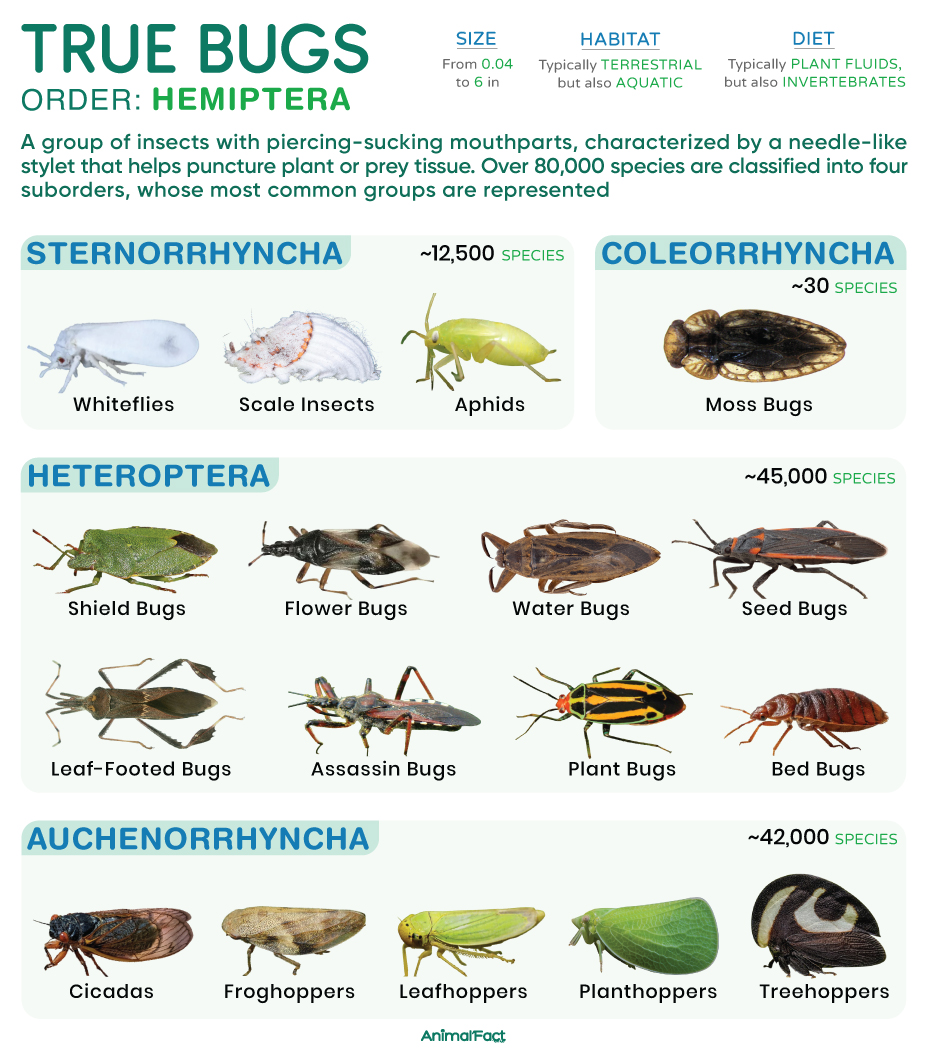
True bugs, also known as hemipterans, are a group of insects that constitute the order Hemiptera, comprising over 80,000 species, including cicadas, aphids, planthoppers, leafhoppers, assassin bugs, bed bugs, and shield bugs.

All true bugs possess piercing-sucking mouthparts, characterized by a needle-like stylet that helps puncture plant or prey tissue and suck out their fluids. While most species feed on plant sap, others are predatory, eating small invertebrates. Some, like bed bugs, are hematophagous, feeding on the blood of vertebrates.
Although most true bugs are terrestrial, some, such as water striders, are typically found in freshwater habitats.
Depending on the species, most true bugs range in size from 0.04 in (0.1 cm) to 6 in (15 cm).
Like all insects, true bugs have a tripartite body plan, having three main body regions: head, thorax, and abdomen.
The head bears a pair of compound eyes, a pair of antennae with 4 to 5 segments, and highly specialized, beak-like mouthparts. The mouthparts, collectively known as the rostrum, comprise a long, segmented labium that acts as a supportive sheath, enclosing a pair of modified mandibles and maxillae that together form a long, needle-like stylet. The stylet has two separate channels, one for delivering saliva outward and another for drawing liquid food inward. During feeding, a salivary pump forces saliva into the prey, helping to pre-digest tissues, while a cibarial pump generates suction to extract fluids.
The thoracic region is subdivided into prothorax, mesothorax, and metathorax. Each of the three subsegments bears a pair of legs, often modified depending on the insect’s lifestyle.
The mesothorax bears the forewings, and the metathorax bears the hindwings. In members of the suborders Sternorrhyncha and Auchenorrhyncha, the forewings are completely membranous, but most members of the suborder Heteroptera possess forewings that are hard near the base, but membranous at the ends, giving them a half-winged appearance (hemelytra).
The hindwings, if present, are fully membranous and typically shorter than the forewings.
The abdominal region consists of a series of 7 to 8 visible segments, each with a dorsal plate (tergite) and a ventral plate (sternite). It contains pairs of spiracles for respiration, the posterior portions of the digestive system, and the reproductive organs, which occupy the terminal abdominal segments in both males and females. While males have an intromittent organ, the aedeagus, females possess an ovipositor for egg-laying.
In many groups, like stink bugs, the abdomen bears the openings of stink glands, which secrete smelly, defensive chemicals.
True bugs derive their scientific name, Hemiptera, from the Ancient Greek words hēmi (meaning half) and pteron (meaning wing), a reference to the half-winged appearance of most heteropterans.
This order is placed under the superorder Paraneoptera, which also includes lice (order Psocodea), thrips (order Thysanoptera). Within Paraneoptera, true bugs are most closely related to the sister group, thrips.
All species are grouped under 4 suborders: Auchenorrhyncha, Coleorrhyncha, Heteroptera, and Sternorrhyncha.
*Only extant families are given in the list.
These insects occur on every continent except Antarctica, with the highest species richness in the tropics. Most true bugs are terrestrial, typically thriving among leafy vegetation. However, some groups, such as water striders, water boatmen, and giant water bugs, live in or on the surface of fresh water. Others, like sea skaters, are typically found in sheltered, coastal habitats.[1]
Most true bugs are phytophagous, meaning they feed on plant fluids. While groups like aphids, whiteflies, and psyllids feed on phloem sap, others, like leafhoppers, spittlebugs, and cicadas, consume xylem sap. Most heteropterans and leafhoppers of the subfamily Typhlocybinae specialize in feeding on non-vascular mesophyll tissue of leaves.
Although typically phloem-feeding, few aphid species, such as the potato aphid (Macrosiphum euphorbiae), have been observed feeding on xylem, particularly under osmotic stress.[2]
Some members, such as minute pirate bugs (family Anthocoridae), are predators that typically feed on the eggs and larvae of other insects like thrips, jumping plant lice, and whiteflies.[3]
Others, such as bed bugs (genus Cimex) and kissing bugs of the subfamily Triatominae, are hematophagous ectoparasites that consume the blood of vertebrates, particularly humans.[4][5]
These insects feed by piercing their food source with their pointed stylets, injecting enzymes to pre-digest the tissues outside their bodies. They then suck up the liquified food using the cibarial pump.
Although most true bugs are capable of flight, different groups have adapted to various modes of locomotion, depending on their habitats. For instance, water scorpions and backswimmers use their legs as paddles to move through water, whereas water striders use the surface tension of water to skate on its surface.
Members of the genus Microvelia move by releasing a surfactant that lowers the surface tension behind them. As a result, the water pulls the insect toward the front, where surface tension is higher, and this difference drives the animal forward (Marangoni effect).[6]
Cicadas, leafhoppers, treehoppers, planthoppers, and froghoppers are all capable of jumping. Froghoppers, in particular, are among the best jumpers in the animal kingdom, with some species able to leap approximately 100 to 115 times their own body length.[7]
In contrast to the variation in locomotion seen across most true bugs, females of a few groups, such as scale insects, tend toward a sedentary lifestyle, lacking wings and often even legs.[8]
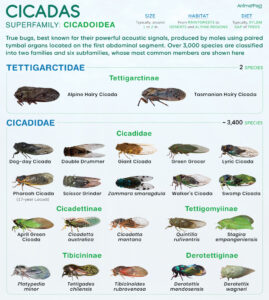
Many true bugs communicate with their conspecifics using acoustic signals. Male cicadas, for instance, have the loudest clicks among insects, which they produce using specialized tymbal organs on the underside of the abdomen. Other groups, like the families Corixidae and Notonectidae, rub their tibial combs on their bodies (stridulation) to produce chirps.
Being a diverse order, the lifespan of true bugs varies among the different subgroups. For example, aphids have an average lifespan of one month, whereas bed bugs live around 6 months to a year, provided they have regular access to blood meals and favorable temperatures.[9][10]
Most true bugs reproduce sexually, with the male transferring sperm to the female’s body for fertilizing her eggs internally. However, most aphids exhibit reproductive polyphenism, meaning they switch from sexual to asexual (parthenogenetic) reproduction, particularly during spring and summer when food is abundant.
The fertilized eggs undergo hemimetabolism, transforming into nymphs, bypassing the pupal stage. The nymphs, which resemble miniature adults, molt several times to develop functional wings and sexual organs, ultimately emerging as adults.
They are typically preyed upon by vertebrates, such as birds, frogs, and lizards, as well as invertebrates, like spiders and other insects, including beetles and lacewings. Moreover, predatory true bugs, such as assassin bugs, minute pirate bugs, and damsel bugs (family Nabidae), prey on other true bugs.
Welcome to AnimalFact - your go-to source for fascinating insights into the amazing world of animals!