Fireflies, also called lightning bugs or glowworms, are a group of insects, many of which are bioluminescent, possessing special light-producing organs on the underside of their abdomen. The light results from a biochemical reaction involving the enzyme firefly luciferase, which acts on the compound firefly luciferin in the presence of oxygen. Although they are called ‘flies,’ these insects actually belong to Lampyridae, a family of beetles within the order Coleoptera.

About 2,000 species of fireflies typically occur in warm, humid habitats worldwide, except in Antarctica.
These insects range in size from 5 to 25 mm (0.2 to 1 in).[1]
As beetles, fireflies have a basic segmented body divided into three main parts (tripartite body plan): head, thorax, and abdomen.
The head typically bears a pair of thread-like antennae, large compound eyes, and chewing-type mouthparts.
The thoracic region is subdivided into three subsegments: pro-, meso, and metathorax, with each subsegment bearing a pair of walking legs. A shield-like plate, the pronotum, covers the prothoracic region.
The mesothorax bears the forewings, which are modified into hard elytra that cover the hindwings. The metathorax bears the membranous hindwings, which are used for flight.
The abdominal region, typically consisting of 8 visible segments, is covered by a thin cuticle that allows light to pass through in luminous species. Each abdominal segment comprises a dorsal plate (tergum) and a ventral plate (sternum), along with pairs of spiracles for respiration.
In bioluminescent fireflies, the abdomen bears specialized light-producing organs called photophores. These are typically located on the sixth and seventh abdominal segments. Adult males usually possess larger and brighter photophores, which they use to signal to females during flight. Females, when photophores are present, possess smaller luminous areas and emit a faint light only.

According to Martin et al. (2019), the family Lampyridae is divided into 11 recognized subfamilies.[2]

The oldest known firefly fossils, belonging to the genera Protoluciola and Flammarionella, date back to about 99 million years ago, during the Late Cretaceous Period.
These insects are particularly abundant in warm, humid regions of the tropics, though some species also occur in temperate climates. Most fireflies are found in marshes or in wet, woody areas, which provide sufficient resources for their larvae to feed on.
The diet of fireflies varies through the different stages of their life cycle. For instance, their larvae are predators and feed mainly on soft-bodied invertebrates such as snails, slugs, earthworms, and the larvae of other insects. In contrast, the adults consume plant sap, pollen, and nectar. In fact, adults of many species, such as the common glowworm (Lampyris noctiluca), are born only to mate and lay eggs, and they do not feed at all.[3]
Most fireflies are active at dusk or night, though a few species, such as Lucidota atra, are diurnal.
Species that possess light-emitting organs typically use their bioluminescence for mating, species recognition, and defense. They are capable of producing firefly luciferase, an enzyme that acts on firefly luciferin, a light-emitting compound exclusively produced by these insects. The reaction, in the presence of magnesium ions, ATP, and oxygen, emits light. Depending on the species, the wavelength of light produced ranges from 510 to 670 nm, flashing shades of yellow, green, or pale red.
Some species of fireflies exhibit synchrony in their flashing behavior. For instance, in Photinus carolinus, found in the Great Smoky Mountains of the United States, large groups of males coordinate their bioluminescent signals, a phenomenon described as phase synchronization and spontaneous order.[4]
This bioluminescent behavior also serves as a warning to predators. Some fireflies, particularly those in the genus Photinus, produce toxic steroidal compounds known as lucibufagins. These chemicals act as powerful defenses, making the fireflies bitter-tasting and unpalatable. In this way, their bioluminescence functions as a visual signal, warning potential predators to stay away.[5]
Fireflies typically live about 2 months in the wild.[6]
These insects reproduce sexually, with their courtship relying heavily on bioluminescent communication. Species that are non-bioluminescent use pheromones to signal their potential mates.
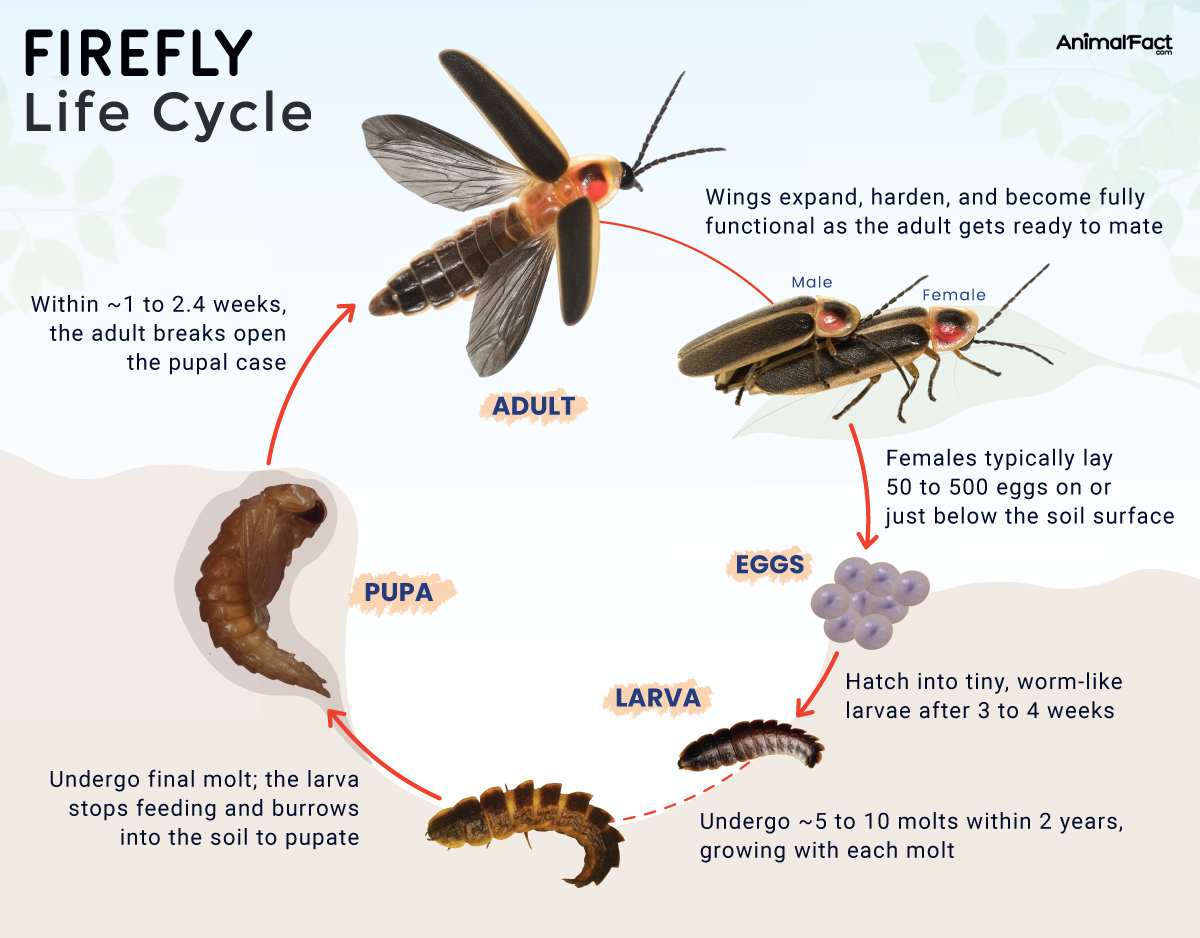
During dusk or night, male fireflies fly around, emitting species-specific flash patterns. If interested, the females, typically on the ground, respond with precisely timed flashes. This exchange of flashes continues until the male locates the female. The pair then copulates, often for several hours, with the male transferring a packet of sperm (spermatophore) to the female’s reproductive tract. After fertilization, the female lays 50 to 500 eggs on or just below the soil surface, depending on the species. After 3 to 4 weeks, the eggs hatch into worm-like larvae, which then begin feeding. The larvae undergo 5 to 10 molts within 2 years. After the final molt, the larva stops feeding and burrows into the soil to pupate. In 1 to 2 weeks, the adult emerges from the pupal case with fully developed wings. The wings harden with time, and the adult gradually attains sexual maturity.
Although many fireflies are extremely distasteful to their predators, they become targets of nocturnal birds. Their larvae and non-glowing adults, in particular, fall prey to frogs, lizards, and occasionally small mammals. Additionally, they may also get trapped in the webs of spiders.
Moreover, some firefly adults may eat each other. For instance, female Photuris fireflies prey on Photinus males to acquire the defensive steroids that they themselves cannot produce.[7]
Welcome to AnimalFact - your go-to source for fascinating insights into the amazing world of animals!